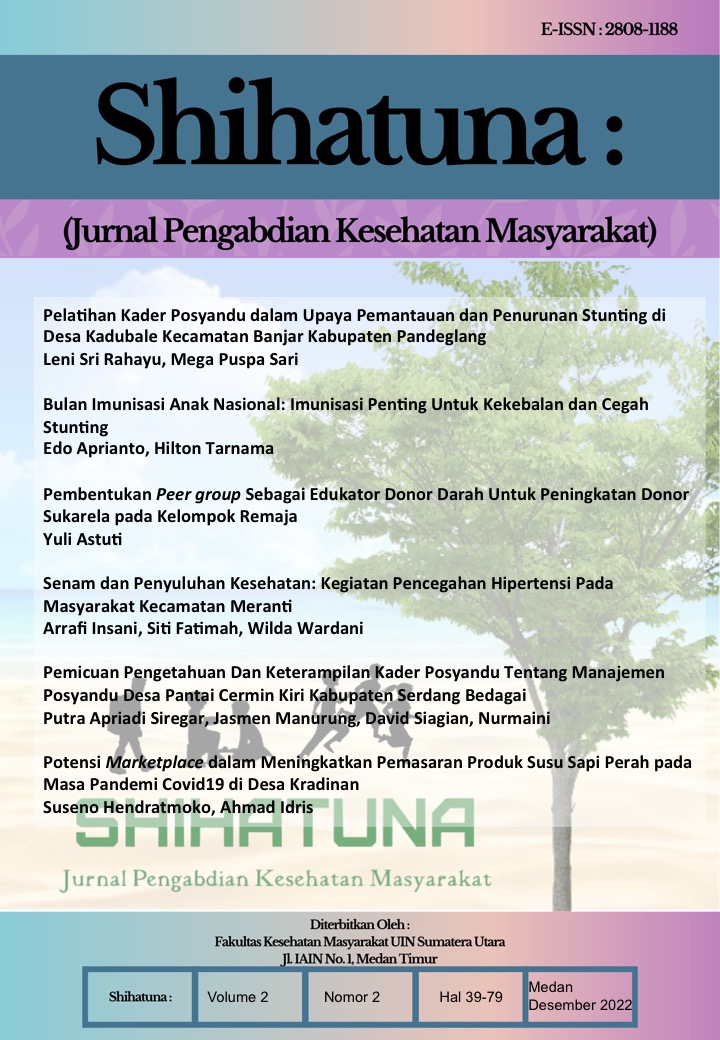
Pembentukan Peer group Sebagai Edukator Donor Darah Untuk Peningkatan Donor Sukarela pada Kelompok Remaja
DOI:
https://doi.org/10.30829/shihatuna.v2i2.12570Keywords:
Keyword, Peer group, Blood donation, TeenagerAbstract
Blood service is an activity that starts from the recruitment and selection of donors, blood collection, blood safety, processing of blood components, and blood distribution. Teenagers as one of the targets of donor recruitment need to provide good information and education, peer groups are a good tool to use for students. Objective of this community service is to disseminate information about safe blood donation to adolescents, and to establish peer groups as blood donor educators. Methode the implementation of this activity is planned in stages, namely: the preparation stage, and the implementation stage. The preparation stages include obtaining permits, preliminary studies with field observations, collecting materials and preparing tools and materials during activities as well as coordinating with related parties. The stages of implementing the activity are conducting socialization about safe blood donors for adolescents, and the formation of peer groups as blood donor educators. Results of this community service there is an increase in knowledge before and after being given socialization from those with less knowledge with a percentage of 15.07% decreasing to 6.12% and those with good knowledge from (17.87%) increasing to (28.57%). Based on community services is that there is an increase in knowledge before and after being given socialization.References
Achilikie B. 2017. Influence Of Peer Group On Adolescent Learning. IJCR. Vol. 9, Issue, 03, Pp.48449-48451, March, 2017.
Beyene. 2020. Voluntary Blood Donation Knowledge, Attitudes, And Practices In Central Ethiopia. IJGM. 2020:13 67-76.
Bloch E, Mast A, Casandra, Josepshon, Harvey, Klein, Anne, Eder. 2017. Teenage Blood Donors: Are We Asking Too Little And Taking Too Much?. Pediatrics. 2017;139(4):E20162955. Doi:10.1542/Peds.2016-295.
Infodatin. 2014. Pusat Data Dan Informasi Kementrian Kesehatan Republik Indonesia. Jakarta. ISSN: 2442-7659.
Kapti, R. E., Rustina, Y., & Widyastuti. (2013). Efektifitas Audiovisual Sebagai Media Penyuluhan Kesehatan Terhadap Peningkatan Pengetahuan Dan Sikap Ibu Dalam Pemahaman Pemasangan IUD. Jurnal Ilmu Keperawatan.
Peraturan Menteri Kesehatan Nomor 91 Tahun 2015 Tentang Standar Pelayanan Transfusi Darah
Peraturan Menteri Kesehatan Nomor 83 Tahun 2014 Tentang Unit Transfusi Darah, Bank Darah Rumah Sakit, Dan Jejaring Pelayanan Transfusi Darah.
Rizki, Marzuki. 2014. Implementasi Nilai-Nilai Karakter Dalam Kegiatan Palang Merah Remaja Di Sekolah Binaan PMI. HSJPI. Vol(1) No (1), 2014.
Santos J, Firmo C. 2019. Knowledge, Attitude And Practice On Blood Donation Among University Students: A Systematic Review Of Literature. MJMR. Vol 3 (1) JANUARY 2019. DOI:10.31674/Mjmr.2019.V03i01.004.
Senaldi E. 2019. Donor Recruitment: Motivate Their Hearts. Ann Blood . 2019;4:19.
Solfema, Wahid S. 2018. Peer Group Learning Method To Improve The College Student's Achievement. JNE 4 (2) (2018). DOI: Http://Dx.Doi.Org/10.15294/Jne.V4i2.16008.
Suryani D, Rizal A, Eliana, Darwis, Pratiwi B, Anggraini W, Yandrizal. 2019. The Effect Of Counseling In Efforts To Prevent And Control Non-Communicable Diseases. KEMAS 14 (3) (2019) 297-302.
Yang J, Li S, Bei C, He B, Chen J, Liang H, Fu Y. 2020. Blood Donor Recruitment In Guangzhou, China, During The 2019 Novel Coronavirus (COVID-19) Epidemic. Transfusion. 2020;60:2597-2610. DOI: 10.1111/Trf.15971.
Downloads
Published
Issue
Section
License
COPYRIGHT
Authors who publish with this journal agree to the following terms:
- Authors retain copyright and grant the journal right of first publication with the work simultaneously licensed under a Creative Commons Attribution-ShareAlike 4.0 International License that allows others to share the work with an acknowledgment of the work's authorship and initial publication in this journal.
- Authors are able to enter into separate, additional contractual arrangements for the non-exclusive distribution of the journal's published version of the work (e.g., post it to an institutional repository or publish it in a book), with an acknowledgment of its initial publication in this journal.
- Authors are permitted and encouraged to post their work online (e.g., in institutional repositories or on their website) prior to and during the submission process, as it can lead to productive exchanges as well as earlier and greater citation of published work (see The Effect of Open Access).
