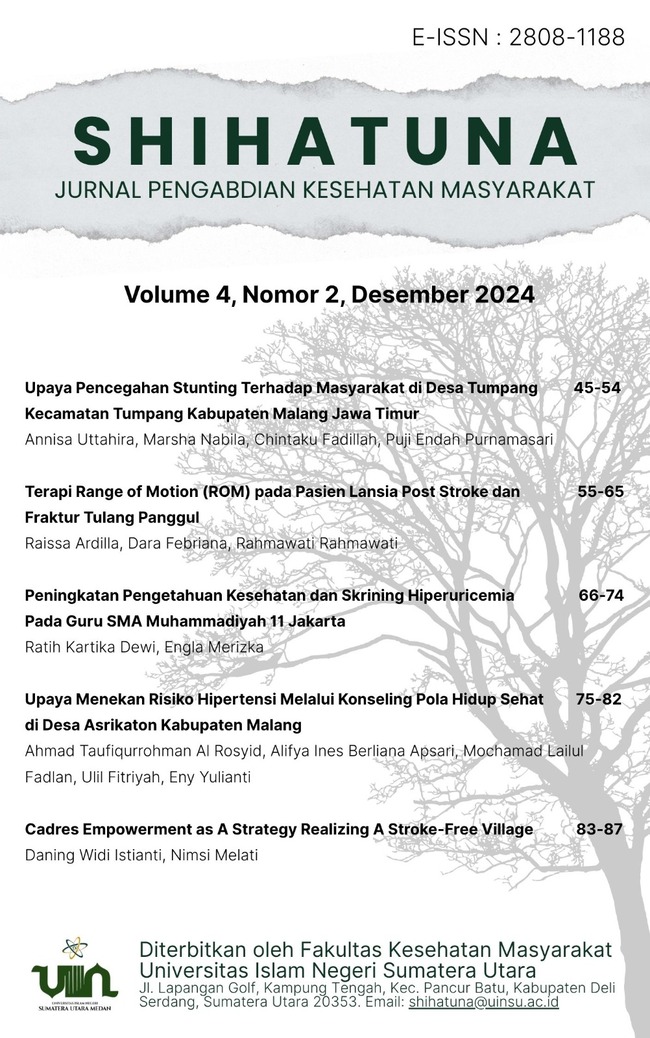
Cadres Empowerment as A Strategy Realizing A Stroke-Free Village
DOI:
https://doi.org/10.30829/shihatuna.v4i2.21289Keywords:
empowerment, cadres, strokeAbstract
Stroke is one of the complications of hypertension. Stroke in Indonesia is the third most deadly disease after heart disease and cancer. The community has an important role in improving health by preventing and promoting health, especially cadres. Preliminaries on the Wirogunan showed that cadres needed assistance in realizing a stroke-free village. The purpose of this community service is to improve cadre skills and awareness in preventing hypertensive complications through screening training and increasing cadres' confidence in providing information to the community with hypertension so that it does not develop into a stroke. The implemented activities include identifying the problems through focus group discussion, introducing strokes, screening training, cadre assistance, and evaluation. There were 23 cadres participating in this activity from RW 8, 9, and 10. The results of community service showed that there is an increase in cadre knowledge, increased skills in conducting screening, and increased self-confidence in cadres in providing education to the community. This program is expected to be carried out in an integrated manner with other sectors to reduce the number of people with stroke.References
Basuni, H. L., Sari, A. S., Rosidi, A., Yuliyanti, S., Aufia, A., Ikhwani, D. A., & Taufandas, M. (2023). Edukasi Metode Face, Arm, Speech Test (Fast) Sebagai Deteksi Dini Stroke Di Area Prehospital Pada Masyarakat Di Desa Wanasaba Lauk Kecamatan Wanasaba Kabupaten Lombok Timur. Indonesian Journal of Community Dedication, 5(1), 19-23.
Didah, Bestari, A. D., & Nirmala, S. A. (2020). Upaya Peningkatan Pengetahuan Kader Posyandu di Desa Cijeruk Kecamatan Pamulihan Kabupaten Sumedang. Jurnal Kreativitas Pengabdian Kepada Masyarakat , 3(1), 199-205.
Eliana, & Sumiati, S. (2016). Kesehatan Masyarakat. Pusdik SDM Kesehatan.
Haris, Pabanne, F. U., & Syamsiah. (2022). Pelatihan Kader Kesehatan dan Aplikasi Edukasi Faktor Risiko Penyakit Tidak Menular. 5(2), 137-150.
Hasanuddin, I., AL, J. P., Hariadi, & Sulaeman. (2021). Faktor Yang Berhubungan Dengan Keaktifan Kader Dalam Pelaksanaan Posyandu. Jurnal Ilmiah Kesehatan Pencerah, 10(1), 38-44. https://doi.org/doi.org/10.12345/jikp.v10i1.221
Kholifah, S. N., & Widagdo, W. (2016). Keperawatan Keluarga dan Komunitas. Kementrian Kesehatan Republik Indonesia.
Lima F De, Titaley CR, Que BJ, Landri M, Malakauseya V, Hussein AL, Saptenno L, Ohoiulun A, Lieasy LS, Wijaya AE, Ulandari P, . (2020). Trust in Cadres in Running Health Services at PTM Posbindu on Saparua Island and Ambon City (Kepercayaan Terhadap Kader Dalam Menjalankan Pelayanan Kesehatan Pada Posbindu PTM Di Pulau Saparua Dan Kota Ambon). Angewandte Chemie International Edition, 14, 12-25.
Saleh Dunggio, A. R., Hitijahubessy, C. N. M., & Setyowati, S. E. (2021). Trainning of Fasilitator Bagi Kader Kesehatan Program Penyakit Tidak Menular dalam Pencegahan dan Pengendalian Potensi Stroke. Poltekita: Jurnal Pengabdian Masyarakat, 2(1), 21-27. https://doi.org/10.33860/pjpm.v2i1.357
Santosa, W. R. B., & Trisnain, A. N. S. (2019). Pengaruh Pendidikan Kesehatan Pre-Hospital Stroke Terhadap Pengetahuan Dan Self-Efficacy Masyarakat Dalam Melakukan Tindakan Pertolongan Pre-Hospital Stroke. Jurnal Gawat Darurat , 1(1).
Zainab, & Marlinda, E. (2020). Pengaruh Pendampingan Kader Kesehatan Terhadap Peningkatan Kesehatan Keluarga Di Wilayah Kerja Puskesmas Astambul Kabupaten Banjar. Jurnal Citra Keperawatan, 8(1).
Downloads
Published
Issue
Section
License
COPYRIGHT
Authors who publish with this journal agree to the following terms:
- Authors retain copyright and grant the journal right of first publication with the work simultaneously licensed under a Creative Commons Attribution-ShareAlike 4.0 International License that allows others to share the work with an acknowledgment of the work's authorship and initial publication in this journal.
- Authors are able to enter into separate, additional contractual arrangements for the non-exclusive distribution of the journal's published version of the work (e.g., post it to an institutional repository or publish it in a book), with an acknowledgment of its initial publication in this journal.
- Authors are permitted and encouraged to post their work online (e.g., in institutional repositories or on their website) prior to and during the submission process, as it can lead to productive exchanges as well as earlier and greater citation of published work (see The Effect of Open Access).
