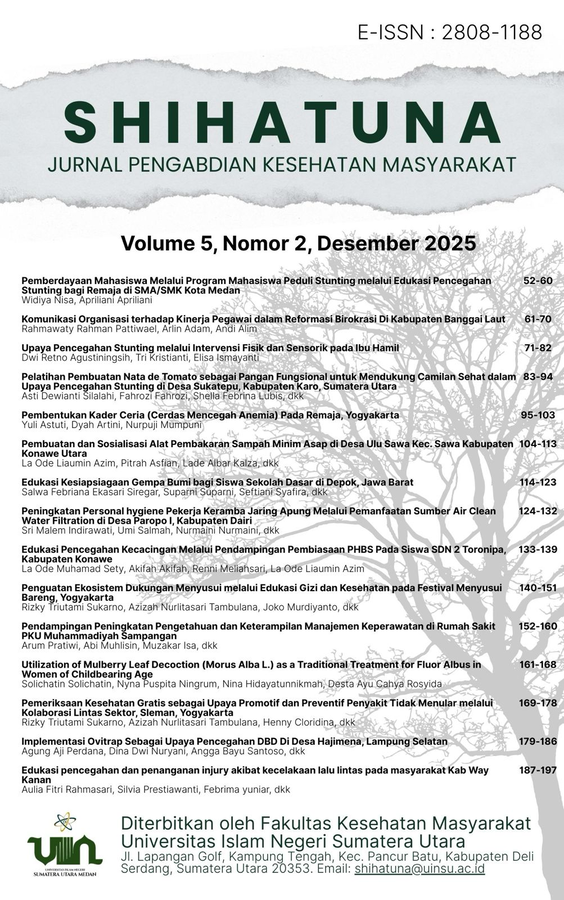
Pemeriksaan Kesehatan Gratis sebagai Upaya Promotif dan Preventif Penyakit Tidak Menular melalui Kolaborasi Lintas Sektor, Sleman, Yogyakarta
DOI:
https://doi.org/10.30829/shihatuna.v5i2.26817Keywords:
Community-Based Screening, Non-Communicable Diseases, Preventive Intervention, Public Health Education, Risk DetectionAbstract
Non-communicable diseases (NCDs) such as hypertension, diabetes, and obesity represent a significant public health burden in Indonesia, including the Special Region of Yogyakarta. To enhance early detection and preventive action, the Faculty of Medicine, Universitas ‘Aisyiyah Yogyakarta, in collaboration with the Sleman District Health Office through Puskesmas Gamping 2, conducted a Free Health Check-up on Sunday, October 12, 2025, from 08.00 to 12.00 WIB at the Siti Bariyah Building, Faculty of Medicine UNISA Yogyakarta. This community service employed a Participatory Action Research approach, engaging participants throughout the process from registration, anthropometric measurements, vital signs assessment, simple laboratory tests, and visual acuity checks, to medical consultation, personalized health education, symptomatic medication, and referral for at-risk individuals. Among 141 participants, the majority were young adults (20-29 years) and female; 33.3% were classified as obese, 44.0% as pre-hypertensive, 7.1% as pre-diabetic, and 60.3% had abnormal cholesterol levels. The intervention facilitated early identification of NCD risk, immediate preventive measures, and referral to health services for high-risk participants. The program also strengthened the framework for sustainable community-based screening, provided practical experience for medical students, and established a replicable model of promotive and preventive collaboration between academic institutions and local health authorities. The results demonstrate that structured community interventions combining screening, education, and follow-up can effectively contribute to NCD prevention and support long-term public health initiatives.References
Abebe, M. G., et al. (2024). Prevalence and associated factors of refractive error among adults in Hawassa City, Ethiopia. PLoS ONE, 19(3), e0299452. https://journals.plos.org/plosone/article?id=10.1371/journal.pone.0299452
Afandi, A., Laily, N., & Noor Wahyudi, M. H. U. (2022). Metodologi pengabdian masyarakat (PAR, CBR, SL, ABCD). Jakarta: Direktorat Pendidikan Tinggi Keagamaan Islam, Kementerian Agama RI. https://repository.uinjkt.ac.id/dspace/bitstream/123456789/71356/1/Buku.pdf
Burnet Institute. (2024). Non-communicable diseases in adolescents in Indonesia. https://www.burnet.edu.au/research/projects/non-communicable-diseases-in-adolescents-in-indonesia/
Cini, K. I., Wulan, N. R., Dumuid, D., Triputri, A. N., Abbsar, I., Li, L., Priambodo, D. A., Sameve, G. E., Camellia, A., Francis, K. L., Sawyer, S. M., Patton, G. C., Ansariadi, A., & Azzopardi, P. S. (2023). Towards responsive policy and actions to address non-communicable disease risks amongst adolescents in Indonesia: Insights from key stakeholders. The Lancet Regional Health - Southeast Asia, 11, 100260. https://doi.org/10.1016/j.lansea.2023.100260
Dinas Kesehatan Kabupaten Sleman. (2024). Profil Kesehatan Kabupaten Sleman 2024. https://dinkes.slemankab.go.id/category/unduh-dokumen/
Dinas Kesehatan Kabupaten Sleman. (2025). Dashboard/Profil Dinkes (akses data 2024-2025). https://sites.google.com/view/profil-dinkes
Fritz, M., et al. (2024). Effectiveness of community-based diabetes and hypertension screening in Indonesia and Viet Nam (SUNI-SEA). BMJ Global Health, 9, e015053. https://gh.bmj.com/content/9/5/e015053
Hanifa, R. S., et al. (2025). Cost-effectiveness of community-based type 2 diabetes interventions in Indonesia. BMJ Public Health, 3(2), e002161. https://bmjpublichealth.bmj.com/content/3/2/e002161
Hashemi, H., Fotouhi, A., Yekta, A., Pakzad, R., Ostadimoghaddam, H., & Khabazkhoob, M. (2017). Global and regional estimates of prevalence of refractive errors: Systematic review and meta-analysis. Ophthalmology, 124(12), 1784-1792. https://doi.org/10.1016/j.ophtha.2017.06.021
Kementerian Kesehatan Republik Indonesia. (2016). Buku panduan Gerakan Masyarakat Hidup Sehat (GERMAS). Jakarta: Kementerian Kesehatan RI. https://dinkes.slemankab.go.id/wp-content/uploads/2020/03/buku-panduan-germas-final.pdf
Kementerian Kesehatan Republik Indonesia. (2015). Rencana Aksi Nasional Pencegahan dan Penanggulangan PTM 2015-2019. https://repository.kemkes.go.id/book/615
Lawton, R., et al. (2024). Explaining adverse cholesterol levels and distinct gender biomarkers in Indonesia: Evidence from a younger population. Journal of Lipid Research & Metabolism, XX(X), XXX-XXX. https://www.sciencedirect.com/science/article/pii/S1570677X24000558
Martinez-Vázquez, S. E., Rodríguez-Morán, M., & Guerrero-Romero, F. (2025). The impact of dietary sugars and saturated fats on body lipids and metabolic risk: An overview. Nutrients, 17(8), 1328. https://doi.org/10.3390/nu17081328
Popkin, B. M. (2022). The nutrition transition to a stage of high obesity and noncommunicable disease risk. Obesity Reviews, 23(12), e13366. https://doi.org/10.1111/obr.13366
Rahman, M. M., et al. (2024). Trends and social determinants of the obesity epidemic among reproductive-age women in ten Asian countries. Scientific Reports, 14, 20567. https://www.nature.com/articles/s41598-024-73556-9
Reardon, T., Tschirley, D., & Minten, B. (2014). Urbanization, diet change, and transformation of food systems in Asia. FAO. https://www.fao.org/fileadmin/templates/ags/docs/MUFN/DOCUMENTS/MUS_Reardon_2014.pdf
Soibam, D. et al. (2022). Impact of diet and physical activities in preventing type II diabetes in Asian populations. Journal of Health and Nutrition Research, 1(2), 45-53. https://sciencescholar.us/journal/index.php/ijhs/article/view/13140
Tan, K. C. B., & Yeung, R. O. (2024). Obesity in the Asia-Pacific region: Current perspectives. Journal of Asian Pacific Society of Cardiology, 3, e21. https://japscjournal.com/articles/obesity-asia-pacific-region-current-perspectives
Tham, K. W., Soh, A. Z., & Lee, Y. C. (2023). Obesity in South and Southeast Asia-A new consensus. Obesity Reviews, 24(5), e13520. https://doi.org/10.1111/obr.13520
WHO. (2024). Strengthening collaborative linkages for better NCD interventions in Indonesia (SUNI-SEA). https://www.knowledge-action-portal.com/en/content/strengthening-collaborative-linkages-better-ncd-interventions-indonesia
Widyaningsih, V., Augustania, C., Agustia, D., et al. (2025). Opportunities for improvement of community-based non-communicable disease screening practices in Indonesia: A participant satisfaction survey. BMC Health Services Research, 25, 1051. https://doi.org/10.1186/s12913-025-13181-y
World Health Organization. (2023). Hypertension profiles 2023 (methods and dashboards). https://www.who.int/data/gho/data/themes/topics/hypertension-profiles
World Health Organization. (2025). Noncommunicable diseases: Key facts. https://www.who.int/news-room/fact-sheets/detail/noncommunicable-diseases
World Obesity Federation. (2024). World Obesity Atlas 2024. https://data.worldobesity.org/publications/atlas-2024/
Downloads
Published
Issue
Section
License
COPYRIGHT
Authors who publish with this journal agree to the following terms:
- Authors retain copyright and grant the journal right of first publication with the work simultaneously licensed under a Creative Commons Attribution-ShareAlike 4.0 International License that allows others to share the work with an acknowledgment of the work's authorship and initial publication in this journal.
- Authors are able to enter into separate, additional contractual arrangements for the non-exclusive distribution of the journal's published version of the work (e.g., post it to an institutional repository or publish it in a book), with an acknowledgment of its initial publication in this journal.
- Authors are permitted and encouraged to post their work online (e.g., in institutional repositories or on their website) prior to and during the submission process, as it can lead to productive exchanges as well as earlier and greater citation of published work (see The Effect of Open Access).
