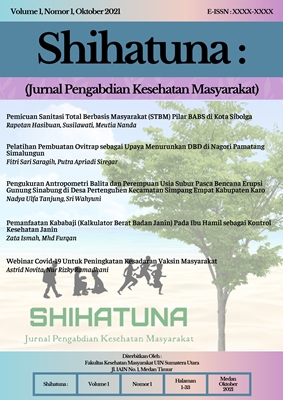
Pelatihan Pembuatan Ovitrap sebagai Upaya Menurunkan DBD di Nagori Pamatang Simalungun
DOI:
https://doi.org/10.30829/shihatuna.v1i1.9189Abstrak
Ovitrap is one of the effective methods in controlling Aedes aegepty sp. Ovitrape is expected to be used by the community to reduce the incidence of dengue fever. The training using video media and leaflets is one way to increase the knowledge and skills of the community in making ovitrap. The purpose of this study was to determine the training in making ovitrap as an effort to reduce dengue hemorrhagic fever. This type of research is quasi-experimental research using a pretest-posttest design. The location in this study was conducted in Nagori Pematang Simalungun, Simalungun Regency. The sample of this research is the entire population (total sampling), namely all cadres who are still active as many as 40 people who are divided into two groups. This study will compare the knowledge and skills in making ovitrape in the film and leaflet media group. This study indicates that leaflet and film media can increase bad knowledge into good knowledge in making ovitrape. Leaflet and film media can improve skills in making ovitrape.Cadres have characteristics with the majority of the age 30-39 years old, complete junior high school education and work as housewives. Training using leaflets and video media can increase knowledge in making ovitrape. Leaflet and film media can improve skills in making ovitrape.Referensi
Aditama, W. (2015). Efektivitas Ovitrap Bambu terhadap Jumlah Jentik Aedes sp yang Terperangkap. Kesmas: Jurnal Kesehatan Masyarakat Nasional, 9 (4), 369-370.
Alfiantya, P. F. (2018). Pengaruh Variasi Lama Penyimpanan Air Rendaman Jerami Padi terhadap Jumlah Telur Nyamuk Aedes aegypti di Ovitrap Model Kepanjen. Global Medical and Health Communication, 6 (1), 57-62.
Anggraini. (2016). Pengaruh Kondisi Sanitasi Lingkungan Dan Perilaku 3m Plus Terhadap Kejadian Demam Berdarah Dengue Di Kecamatan Purwoharjo Kabupaten Banyuwangi. J Pendidik Geogr, 3 (1), 321-328.
Cahyati. (2016). Penurunan Container Index (CI) Melalui Penerapan Ovitrap Di Sekolah Dasar Kota Semarang. Unnes Journal of Public Health, 5 (4), 330-335. Retrieved from http://journal.unnes.ac.id/sju/index.php/ujph
Dinas Kesehatan Provinsi Sumatera Utara. (2019). Profil Kesehatan Provinsi Sumatera Utara tahun 2018. Provinsi Sumatera Utara. Retrieved from http://dinkes.sumutprov.go.id/v2/download.html
Dinas Kesehatan Provinsi Sumatera Utara. (2020). Profil Kesehatan Provinsi Sumatera Utara Tahun 2019. Medan. Retrieved from http://dinkes.sumutprov.go.id/
Ernyasih. (2019). Hubungan Karakteristik Responden, Pengetahuan dan Sikap Kepala Keluarga Terhadap Praktik Pencegahan Demam Berdarah Dengue (DBD). J Ilmu Kesehat Masy, 8 (1), 6-13.
Fadlilah, I. (2017). Pengaruh Berbagai Jenis Atraktan Pada Lethal Ovitrap Terhadap Nyamuk Yang Terperangkap Di Kelurahan Karangklesem Kecamatan Purwokerto Selatan Kabupaten Banyumas Tahun 2016. Keslingmas, 37 (1), 12-19.
Fatmawati, T. (2014). Distribusi dan Kelimpahan Larva Nyamuk Aedes spp.di Kelurahan Sukorejo Gunungpati Semarang Berdasarkan Peletakan Ovitrap. Universitas Negeri Semarang.
Hamzah, E. (2016). Perbedaan Ovitrap Indeks Botol, Ember dan Port Mosquito Trap sebagai Perangkap Nyamuk Aedes sp. di Area Kantor Kesehatan Pelabuhan Kelas II Samarinda Wilayah Kerja Sangatta Kabupaten Kutai Timur. Higiene, 2 (3), 155-158.
Hidayati, L. (2017). Pemanfaatan Ovitrap Dalam Pengukuran Populasi Aedes sp. dan Penentuan Kondisi Rumah. Jurnal Entomologi Indonesia, 14 (3), 126-134.
Jap, N. (2019). Kepadatan Telur Nyamuk Aedes sp. Berdasarkan Warna Ovitrap Dan Ketinggian Tempat Di Kota Kupang ( Studi kasus pada Kelurahan Oesapa Barat, Batuplat, dan Bello). Timorese Journal of Public Health, 1 (1), 42-51.
Kementrian Kesehatan Repoblik Indonesia. (2020). Profil Kesehatan Indonesia Tahun 2019. In Kementrian Kesehatan Repoblik Indonesia (Vol. 42). Jak.
Kurniawan, T. P. (2016). Studi Angka Bebas Jentik (ABJ) dan Indeks Ovitrap Di Perum Pondok Baru Permai Desa Bulakrejo Kabupaten Sukoharjo. Jurnal Kesehatan, 1 (2), 72-76.
Kurniawati, R. D. (2020). Analisis Pengetahuan dan Motivasi Pemakaian Ovitrap Sebagai Upaya Pengendalian Jentik Nyamuk Aedes Aegepty. Jurnal Ilmu Kesehatan Masyarakat, 9 (4), 248-253. https://doi.org/https://doi.org/10.33221/jikm.v9i04.813
Latifa, K. N. (2016). Pengaruh Ovitrap Sebagai Monitoring Keberadaan Vektor Aedes sp di Kelurahan Bulusan Kecamatan Tembalang Kota Semarang. Jurnal Kesehatan Andalas, 5 (2), 385-389.
Nurjana, M. A. (2017). Preferensi Aedes aegypti Meletakkan Telur pada Berbagai Warna Ovitrap di Laboratorium. BALABA, 13 (1), 37-42. https://doi.org/doi.org/10.22435/blb.v13i1.256
Rati, G. (2016). Perbandingan efektivitas berbagai media ovitrap terhadap jumlah telur Aedes Spp yang Terperangkap di Kelurahan Jati Kota Padang. J Kesehat Andalas, 5 (2), 385-389.
Susianti. (2017). Government Strategy in the Eradication of Dengue Hemorrhagic Fever (DHF) in Jambi City. J Bina Praja, 9 (2), 243-253.
Wahidah, A. (2016). Ovitrap Sebagai Alternatif Pengendalian Vektor DBD di Kelurahan Bulusan. Jurnal Kesehatan Masyarakat, 4 (1), 106-115.
Zuhriyah, L. (2016). Efektifitas Modifikasi Ovitrap Model Kepanjen untuk Menurunkan Angka Kepadatan Larva Aedes aegypti di Malang. Jurnal Kedokteran Brawijaya, 29 (2), 157-164. Retrieved from http://jkb.ub.ac.id/index.php/jkb/article/view/1247
Unduhan
Diterbitkan
Terbitan
Bagian
Lisensi
COPYRIGHT
Authors who publish with this journal agree to the following terms:
- Authors retain copyright and grant the journal right of first publication with the work simultaneously licensed under a Creative Commons Attribution-ShareAlike 4.0 International License that allows others to share the work with an acknowledgment of the work's authorship and initial publication in this journal.
- Authors are able to enter into separate, additional contractual arrangements for the non-exclusive distribution of the journal's published version of the work (e.g., post it to an institutional repository or publish it in a book), with an acknowledgment of its initial publication in this journal.
- Authors are permitted and encouraged to post their work online (e.g., in institutional repositories or on their website) prior to and during the submission process, as it can lead to productive exchanges as well as earlier and greater citation of published work (see The Effect of Open Access).
